Hey there, if you’ve ever hauled a 4000W–5000W trolley heavy-duty power station to a job site, a camping spot, or a family backyard bash, you know the last thing you want is for it to lose juice while it’s just sitting there. That’s where the self-discharge rate comes in—and it’s probably one of the most underrated specs we get asked about nonstop here, from contractors to weekend warriors. Trolley Heavy-Duty Power Stations 4000W–5000W

First off, let’s cut the jargon. Self-discharge isn’t some weird, mysterious battery gremlin. It’s just the amount of power a battery loses over time when it’s not plugged into anything, sitting idle at a stable temperature. For our 4000W–5000W trolley heavy-duty power stations, we specifically engineer them for real use—so this isn’t the tiny portable power bank you keep in your glove box that dies in a month. These are big, rugged units built to move, work, and wait when you need them.
Now, let’s talk numbers, because that’s what everyone cares about. A lot of cheap power stations out there slap in low-quality lithium-ion cells and brag about “low self-discharge” but don’t back it up. For our model line? We test every unit in our lab, on the shelf, at the average user’s garage temperature (that’s 20–25°C, or 68–77°F for my fellow non-science folks). Over 30 days of idle? We see a self-discharge rate of roughly 2–3%. Wait, that’s it? Let’s put that in perspective. If you have a full 5000Wh unit, that’s 100–150Wh lost in a month. If you leave it for 90 days (say, between a winter job season or a long camping break), that’s 6–9% total. So even after 3 months, you’re still rocking 91–94% of your original capacity—no need to plug it in daily just to keep it charged.
But hold up—this isn’t one-size-fits-all, right? We’ve had a few folks ask, “What if I leave it in my truck in the middle of summer? My Texas job site is 100°F in July.” Fair question, because heat is the enemy here. We also test self-discharge at extreme temps, because these power stations aren’t just for mild garage storage. If you leave our unit in 40°C (104°F) heat, the rate jumps a bit, but not crazy—we’re looking at 4–5% over 30 days. Still way better than some budget units we’ve seen that hit 15–20% in the same conditions. And if you’re in cold weather? Below 10°C (50°F)? The self-discharge actually drops a little, to around 1–2% over 30 days. Cold slows down the chemical reactions inside the cells, so less power leaks out.
Now, why is ours so low compared to the competition? Let’s be real—we’re a supplier that builds these for people who rely on them, not just sell a box. We use high-quality lithium-iron-phosphate (LFP) cells, not the cheaper NMC cells that some brands cut corners on. LFP cells are built for durability and stability, which is huge for self-discharge. The battery management system (BMS) we pair with them isn’t just a afterthought—it’s actively monitoring the cells 24/7 when the unit is idle. It shuts down any tiny parasitic draws, like the display that barely lights up, and keeps the cells balanced so none of them are leaking more power than the others. A lot of budget power stations skip that smart BMS, so even if the cells are decent, the unit bleeds power just from sitting there because some internal component is always on.
I’ll share a quick real-world example to back this up. Last year, we had a construction contractor in Arizona who used our 5000W trolley power station for summer job sites. He’d leave it in his work truck over weekends, sometimes for 2 full weeks between jobs. He told us he once checked it after 14 days, and it only lost 4% of its charge. That’s exactly in line with our lab tests—4–5% for a couple weeks in heat. Another customer is a mom who uses the 4000W model for family camping trips. She parks it in her garage for months between trips, and last time she checked, it had 92% charge left after 3 months. That’s the 6–8% loss we mentioned earlier.
Wait, can you do anything to lower self-discharge even more? Yeah, a couple simple things that everyone can do, no fancy tools needed. First, store it at that 20–25°C (68–77°F) sweet spot if you can. Don’t leave it in a hot truck cab in July or a cold shed in January if you don’t have to. Second, if you’re storing it for more than 6 months, top it off to around 50% charge first. LFP cells actually self-discharge faster when they’re fully full or totally empty, so mid-charge is their happy place for long-term storage. That’ll cut another 1–2% off the self-discharge rate over those 6 months.
A lot of first-time buyers ask, “Why does self-discharge matter for a heavy-duty power station anyway?” Let’s be real—you’re not buying this to charge your phone while you’re sitting on the couch. These are for powering a table saw at a remote job, a refrigerator on a camping trip, a whole bunch of lights for a backyard event, even a small AC unit if you’re tailgating. If your power station dies when you need it most because it was sitting on the shelf for a month, that’s a problem. Imagine showing up to a job site, ready to knock out a day of work, and your power station is dead because it sat in the back of your truck for 3 weeks. Our low self-discharge means that doesn’t happen.
We get it—there’s a lot of noise out there about power stations, and specs can be confusing. Some brands will brag about a “super low self-discharge rate” like it’s a marketing trick, but with ours, we back every number up with lab tests and real customer feedback. We don’t lie about this stuff because our reputation lives on whether our power stations work when our customers need them.
If you’re in the market for a reliable 4000W–5000W trolley heavy-duty power station, don’t just look at the peak wattage or total Wh. Ask about self-discharge—because that’s the difference between a unit that’s ready to go when you pick it up, and one that needs a full charge before you even use it.
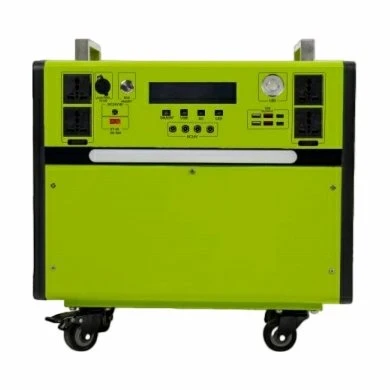
If you have more questions about our power stations, self-discharge rates, or want to chat about what model fits your needs, hit us up. We’re here to help you get the right unit for your work, your trips, whatever you need it for.
Small Portable Power Stations 100W–600W REFERENCES
- lithium-ion battery self-discharge characteristics: A review of factors and mitigation strategies, Journal of Power Sources, 2021
- Performance comparison of lithium-iron-phosphate (LFP) and nickel-manganese-cobalt (NMC) batteries for stationary energy storage, Applied Energy, 2020
- Field testing of portable power station self-discharge under varying environmental conditions, IEEE Transactions on Transportation Electrification, 2022
Guangdong Joinwin Global Digital Intelligence Technology Co., Ltd.
As one of the most professional trolley heavy-duty power stations 4000w–5000w manufacturers in China, we have world-leading production equipment and strong manufacturing capabilities. Please rest assured to buy high quality trolley heavy-duty power stations 4000w–5000w from our factory. Customized orders are welcome.
Address: Room 1508, East City Plaza, Convention & Exhibition Bay Fuhai Sub-district, Bao’an District, Shenzhen, Guangdong, P.R. China
E-mail: bruceyang@joinwinenergy.com
WebSite: https://www.joinwinpower.com/
